
Summary
It sounds too good to be true: drop a signed contract in, get correct Stripe billing out — subscriptions, ramps, net terms, tax details, all of it. But this genuinely works today, and teams run it in production. The recipe is simple: extraction models that have gotten very good at billing-shaped data, prompts fine-tuned by experience for which term types models catch and which they miss, domain experts who know how to pipe those terms into Stripe's complex billing API structure, and a reasonable human review step before anything is created. If your terms already live in structured deal data, you don't even need the AI — deterministic sync is simpler still.
When we tell teams their signed contracts can just become Stripe billing — no transcription, no spreadsheet middle step — the reaction is usually some version of "that can't possibly be safe." Fair. Billing is the one place nobody wants creative AI. And yet: enterprise deals close on negotiated paper with custom unit prices, volume commitments and usage components, and somebody currently re-types all of it into Stripe by hand.
Here's the surprising news: automating that handoff is genuinely possible now. Not as a demo — in production. It just takes the right recipe.
Yes, AI can actually read your contracts
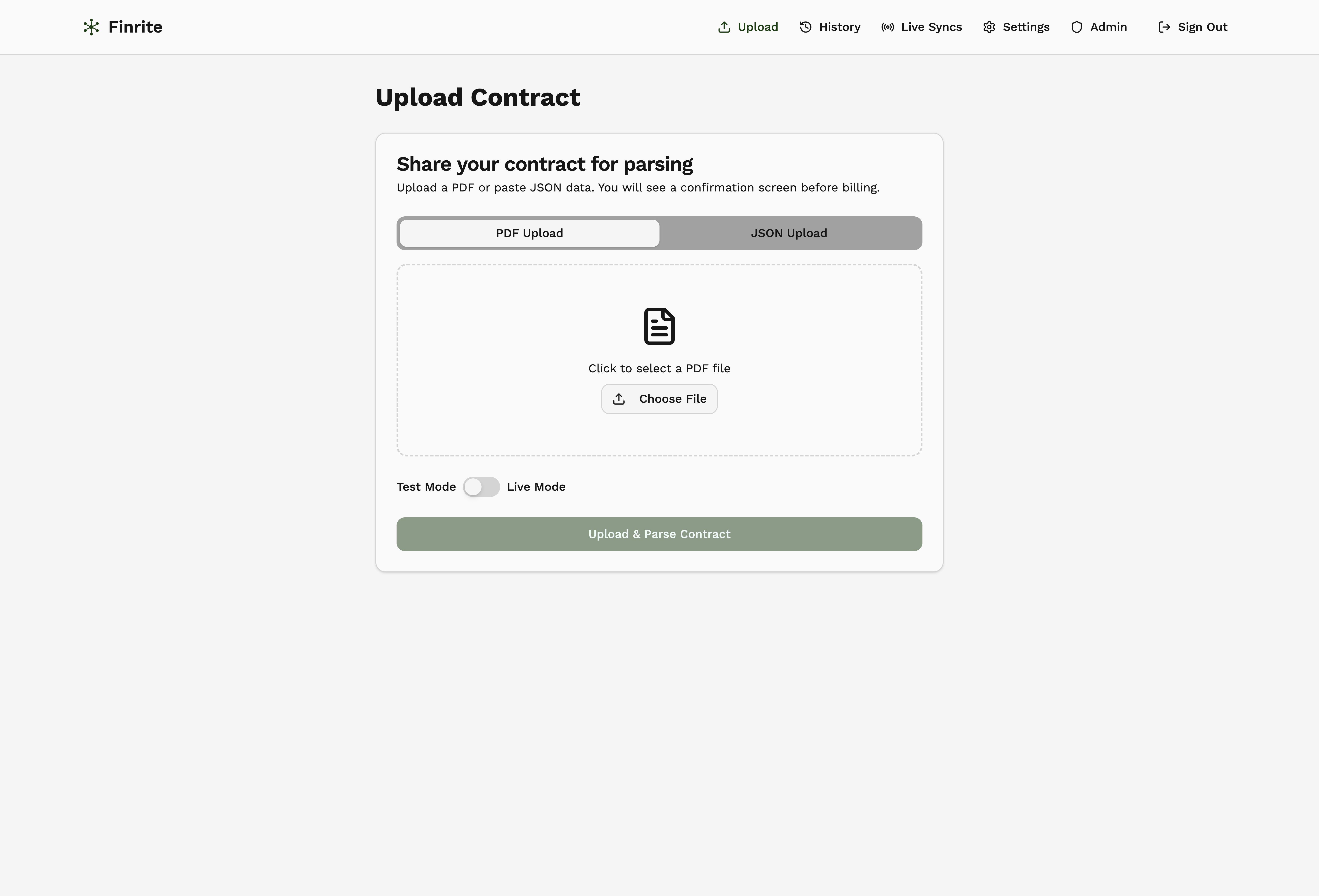
Drop a signed MSA or order form in, and modern extraction reliably pulls out the billing-relevant structure: products and quantities, unit prices, discounts, billing cadence, start dates, multi-step ramps, net payment terms, even customer tax IDs. Finrite's contract ingestor turns that extraction into the corresponding Stripe objects — subscription, schedule, or invoice — with the contract stored and linked to the billing it produced. On clean documents it's excellent; on a scanned, redlined, appendix-riddled enterprise contract, it's still remarkably good.
The hard part isn't reading — it's knowing Stripe
Extracting "$1,000/month, 3-step annual ramp, net 30" is the easy half. The half that separates a toy from a production system is knowing what that means in Stripe: which subscription schedule expresses the ramp, how the discount composes with the proration, where the tax ID lands. That's billing domain expertise, not model capability — and it's why this works when it's built by people who live in Stripe's billing semantics. Our team is ex-Stripe, and we've written about what we learned feeding the Stripe API to AI — the mapping layer is where the real work went.
There's also a compounding advantage that no general-purpose model has: volume. Because so many contracts flow through Finrite into Stripe, we've already seen the common pitfalls — the ramp expressed three different ways in one document, the discount that fights the proration, the net-terms clause hiding in an appendix — long before your contract hits them. That experience feeds straight back into the system: our prompts are fine-tuned for the term types models reliably catch versus the ones they tend to miss, and the mapping layer knows how each extracted term pipes into Stripe's complex billing API structure — schedules, phases, prorations and all. That pattern library, built from real contracts plugged into real Stripe accounts, is the proprietary part.
A reasonable human in the loop makes it trustworthy
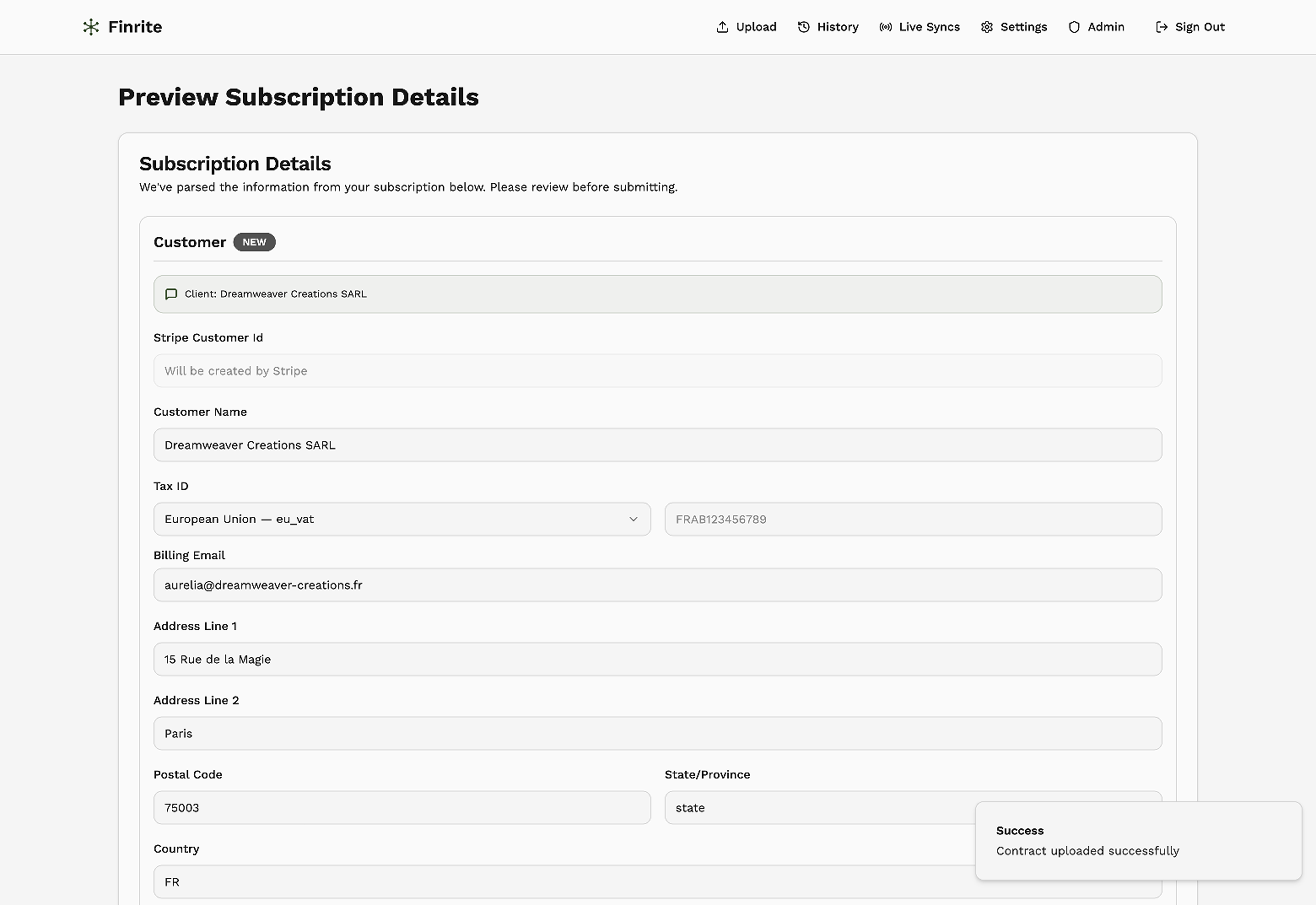
The final ingredient isn't heroic oversight — it's a two-minute review. The parser lays out what it found next to the source document; a person confirms or corrects; approval creates the billing. You get the speed of automation with the confidence of having seen it — and an audit trail for every number. That's a very different posture from trusting a model blindly (which you shouldn't — we've written about why 80% accuracy isn't enough when the output is an invoice). Two minutes of review replacing thirty minutes of transcription is the whole trade, and it's a great one.
When you don't even need the AI
If your pricing already sits in HubSpot deal fields or in quotes generated from deal data, skip the extraction entirely — subscription creation is a deterministic sync problem, simpler and correct by construction. One honest caveat: "terms already in structured fields" is easier said than achieved. In practice it only holds when something upstream enforces the structure — a disciplined deal desk, or a CPQ like Finrite's that generates quotes from deal data so the structure exists from birth. Without that, deal fields quietly drift from the paper, and the contract becomes the real source of truth after all. We've mapped the routes in how to automatically create Stripe subscriptions from HubSpot deals. AI earns its place where the contract is the sole source of truth — which, for negotiated enterprise paper, it often is.
Frequently Asked Questions
Can AI create Stripe subscriptions from a contract PDF?
Yes — and it works in production today. Finrite's AI parser extracts pricing, quantities, cadence, ramps, net terms and tax details from signed contracts and creates the corresponding Stripe subscription, schedule or invoice, after a quick human review of the extraction.
Do I have to trust the AI blindly?
No, and you don't have to — that's the point of the design. The extraction is presented next to the source document for a quick review, and billing is only created on approval. You get automation speed with an audit trail for every number.
Can it handle negotiated enterprise pricing — custom unit prices, volume commitments, usage?
Yes, those are the cases it exists for: custom unit prices, discounts, volume commitments, usage components and multi-step ramps extracted into structured billing terms.
What if my terms are already in HubSpot deal fields?
Then skip AI — a deterministic connector creates the subscription from deal data directly, which is simpler and correct by construction. The catch is keeping those fields accurate: in practice that takes an upstream process or tool, like Finrite's CPQ, that structures the data at the source. AI extraction is for terms that exist only in documents.
Related reading: three routes to automatic subscription creation · why 80% accuracy isn't enough · what we learned feeding the Stripe API to AI · the AI contract ingestor
Contracts in, correct billing out
It sounds crazy until you watch it: signed PDFs in, correct Stripe billing out, with a two-minute review in between.
Get in touch