Is your team looking for a LinePilot alternative because your quoting setup needs a little more than automated line items?
LinePilot can work well if you use HubSpot and want a lightweight way to calculate pricing, apply rules, and create line items from deal data.
But once your sales process starts involving more complex approvals, subscription changes, custom pricing, or billing automation, you may need a broader CPQ solution.
We reviewed the top seven LinePilot CPQ alternatives that give you more room to handle quoting, approvals, contracts, and post-signature workflows.
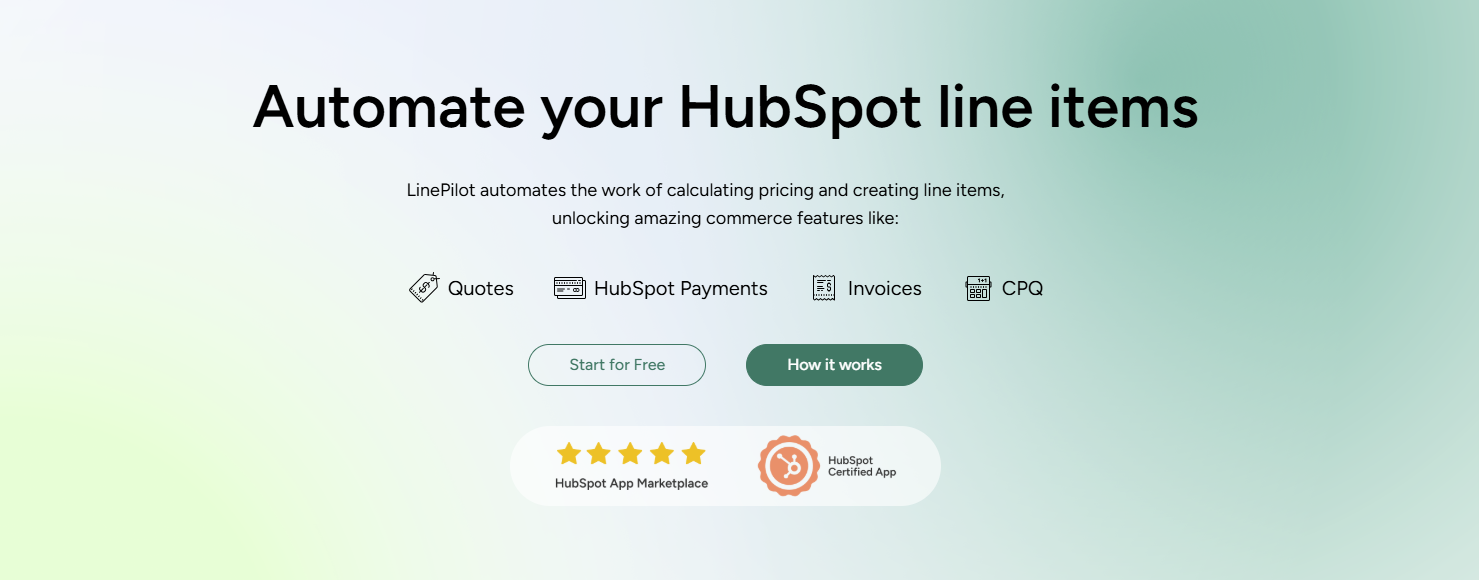
LinePilot is a HubSpot-native tool for automating product line items on deals. You can create templates, use HubSpot deal properties to determine products or quantities, calculate pricing, and automatically populate line items before a rep creates a quote.
Source: LinePilot.co
Rather than replacing HubSpot Sales Hub with a large CPQ solution, LinePilot works with HubSpot's existing product library and commerce features.
It describes itself as a lightweight alternative to larger CPQ software, which can make sense for companies mainly trying to remove manual line-item configuration from their sales process.
A sales team can also use LinePilot to build custom pricing logic around deal properties, including factors like discounts or margin calculations. Once the rules run, HubSpot receives the resulting line items so reps can continue into its quote workflow.
Why Some Companies Look for Alternatives to LinePilot
LinePilot works well for a relatively focused use case, but your requirements may eventually extend further into the quote-to-cash process.
Common reasons for evaluating LinePilot CPQ alternatives include:
More configuration depth: Complex products may require guided selling, product dependencies, configuration rules, or tighter controls over which line items can be sold together.
Advanced pricing rules: A larger pricing model can introduce tiered rates, usage-based pricing, ramps, custom discounting, or account-specific terms.
Stronger approvals: Mid-market and enterprise sales teams may need multistep approval workflows, approval routing, and audit trails.
Quote-to-billing automation: Some businesses want signed quote data to flow directly into subscriptions, invoices, and downstream billing.
Subscription lifecycle support: Renewals, upgrades, amendments, and co-terms can require functionality beyond the initial quote.
Broader revenue operations: Your company may prefer one platform covering CPQ, contracts, billing, or revenue recognition instead of combining several tools.
7 Best CPQ Software in 2026 to Replace LinePilot CPQ
We handpicked these LinePilot CPQ alternatives based on different needs, from CRM-based quoting to more advanced quote-to-revenue workflows. The right fit depends on how you sell, what your current tech stack looks like, and how far you want CPQ to extend after signature:
1. Finrite
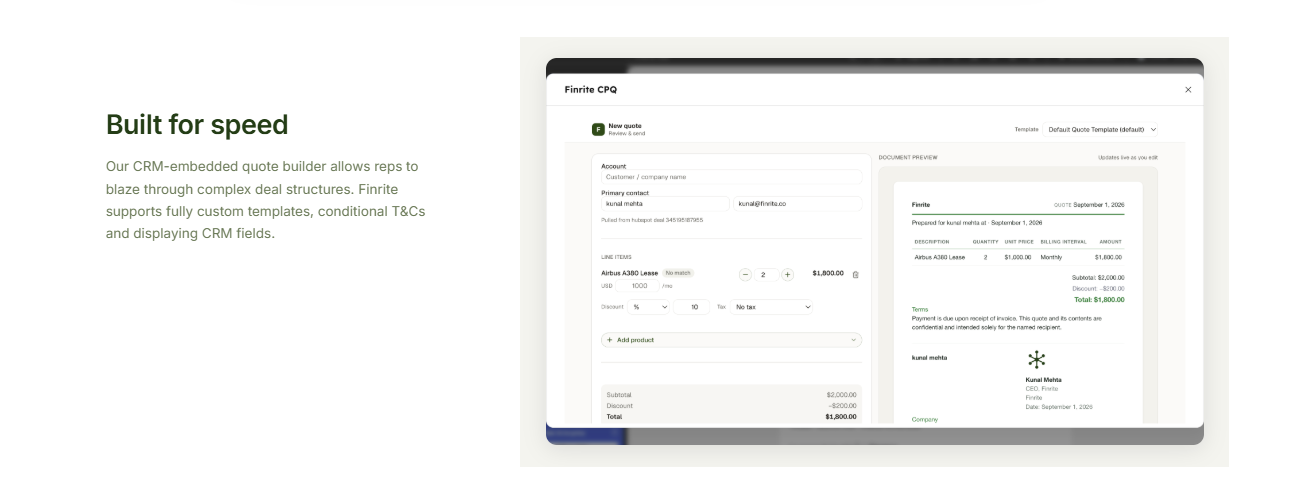
Finrite is a CRM-embedded CPQ and revenue automation platform built for companies that want quoting closely connected to their existing billing infrastructure.
Reps can create quotes from CRM data, collect signatures and payment details, and pass finalized commercial terms into billing.
Finrite is ideal if you already use Stripe Billing because you can add CPQ while keeping Stripe as your billing system.
Renewals and upsells can update existing subscriptions, while more complex pricing structures such as usage and ramp pricing can carry through into billing. Finrite can also ingest contracts or purchase orders and extract the information required to create billing records.
Best Features
CRM-embedded quoting: Create customizable quotes using customer and deal data already stored in your CRM.
Quote-to-billing automation: Carry signed pricing and billing terms into your billing workflow instead of recreating the agreement manually.
Flexible pricing support: Handle recurring charges alongside more complex structures such as usage-based pricing and ramp schedules.
Renewals and amendments: Create renewal or upsell quotes that update existing billing information.
Payment collection: Collect payment details during the quote and signature process.
AI contract parsing: Extract customer details and commercial terms from contracts, POs, and other documents for review before billing records are created.
CRM and billing sync: Keep product and customer information connected between your sales CRM and billing system.
Starter: $200/month: Supports up to 10 contracts per month and includes its HubSpot-to-Stripe connector, automated subscription creation, usage-based billing support, and standard field mapping.
Core: $400/month: Supports up to 50 contracts and adds AI contract parsing, more advanced two-way synchronization, and priority support.
Pro: $1,000/month: Includes unlimited contracts, Finrite's HubSpot-embedded quoting engine, AI contract parsing, custom workflow mapping, and additional integration support.
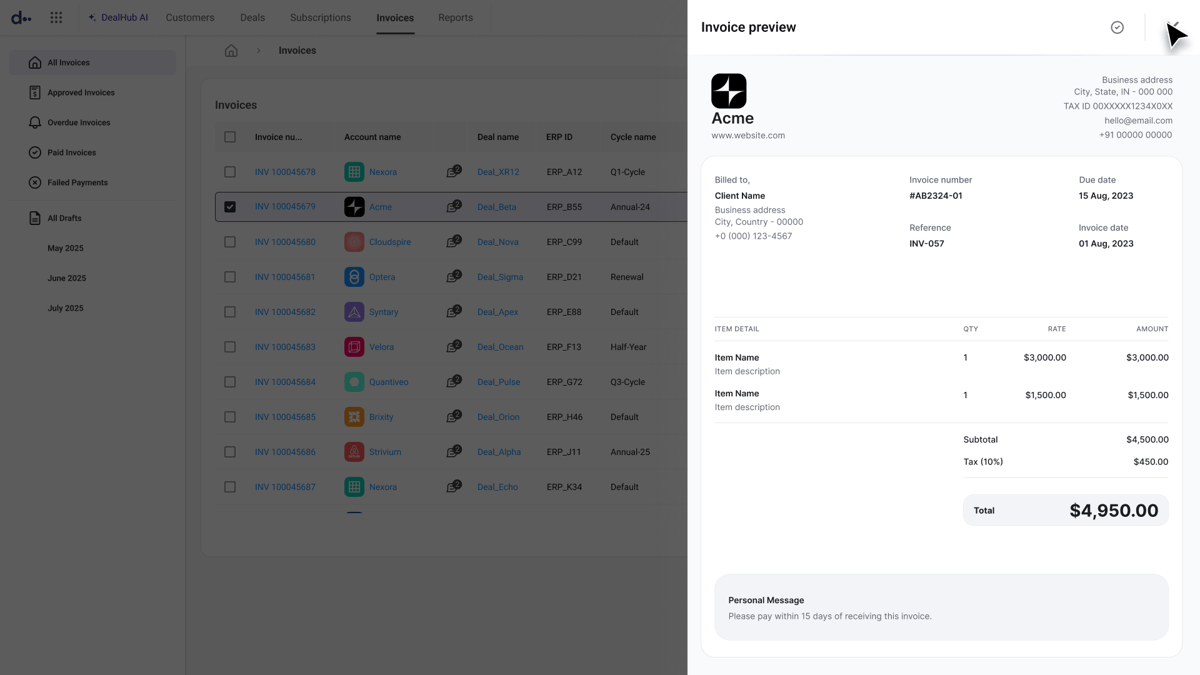
DealHub is a broader quote-to-revenue platform aimed at businesses with more complicated sales processes. Its CPQ software supports guided quote configuration, pricing controls, bundles, discounts, channel quoting, and approval workflows.
Source: G2
The platform extends further into subscription management and billing. Companies looking for one platform to handle a larger portion of revenue operations may find that appealing.
One consideration is how DealHub fits into your existing billing setup. Its broader platform includes its own subscription management and billing capabilities, which may overlap with systems your finance team already uses.
Although DealHub integrates with Stripe for payment processing, businesses planning to keep Stripe Billing should evaluate how quote data and subscription changes will sync between the two platforms. Implementation can also be more involved than adopting a focused CPQ tool.
Best Features
Guided configuration: Help sales reps configure suitable products and commercial structures using predefined business rules.
Pricing controls: Apply discounting rules and approval-aware pricing to quotes.
Approval workflows: Route deals through parallel approval processes based on your commercial requirements.
Subscription management: Manage lifecycle events such as amendments, expansions, renewals, and co-terming.
Billing capabilities: Support invoicing and usage or consumption billing through the broader DealHub platform.
CRM integrations: Connect DealHub with systems including HubSpot, Salesforce, and Microsoft Dynamics.
Pros
Broad quote-to-revenue functionality
Strong configuration and approval features
Supports complex subscription changes
Works with several major CRMs
Includes digital sales room capabilities
Pricing
DealHub does not publish pricing publicly.
3. HubSpot CPQ
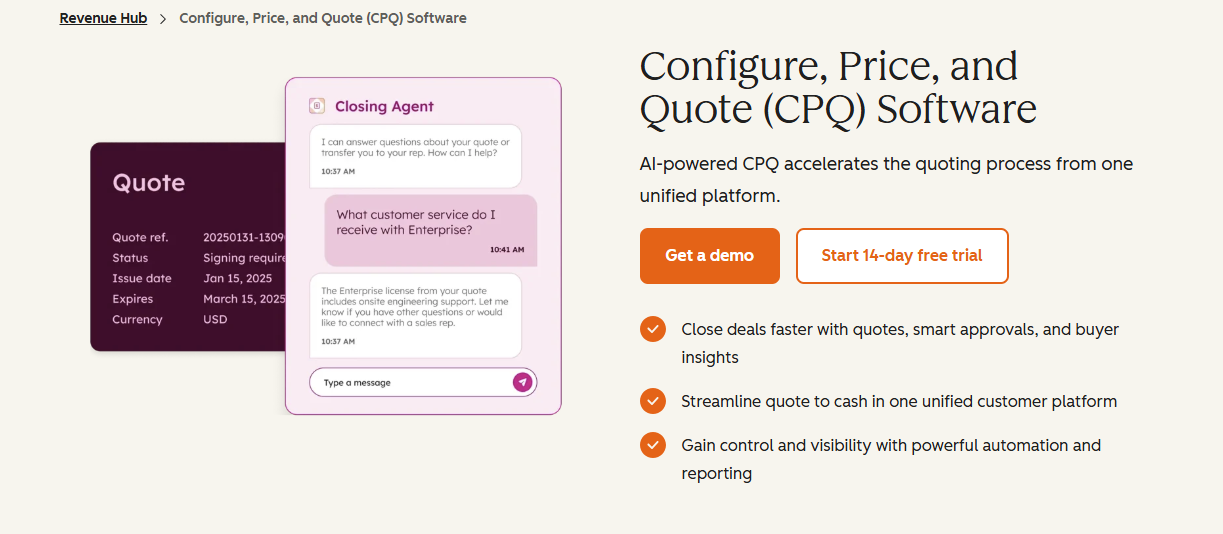
HubSpot CPQ is part of Revenue Hub and is a natural LinePilot alternative if you want to keep the quoting process directly inside HubSpot.
Source: HubSpot.com
Reps can configure deals from the deal record, apply pricing rules, create quotes, and manage approvals in the same CRM environment they already use for sales. Revenue Hub also covers capabilities like contracts, invoicing, payments, and subscriptions.
Compared with dedicated enterprise CPQ tools, HubSpot can offer a more familiar experience for existing HubSpot users. Companies requiring extensive product configuration or highly specialized quote rules should still evaluate how its configuration depth fits their sales process.
HubSpot CPQ also has limitations for businesses already managing subscriptions in Stripe Billing. Connecting Stripe as a payment processor lets you accept payments through HubSpot, but subscriptions and invoices created in HubSpot won't automatically appear in Stripe.
Companies that want signed quotes to create or update Stripe Billing subscriptions will need additional integration capabilities. More advanced quoting requirements may also require upgrading to Revenue Hub Enterprise.
Best Features
Native HubSpot experience: Build and manage quotes from the HubSpot deal record.
Quote rules: Apply rules and controls to how sales reps assemble customer quotes.
Approval workflows: Revenue Hub Enterprise includes advanced quote approvals.
Contracts and signatures: Create customer-facing sales documents and collect e-signatures.
Revenue data: Keep quoting activity connected to the customer and sales information stored in HubSpot.
Payment options: Connect the revenue workflow with HubSpot's payment functionality or supported payment integrations.
Pros
Familiar interface for HubSpot users
Minimal CRM switching
Built into the wider HubSpot platform
Quotes stay connected to CRM data
Includes broader revenue tools
Pricing
HubSpot currently lists the following Revenue Hub pricing:
Free: Includes tools such as invoices, payment links, and subscriptions, but not the full CPQ feature set.
Professional: Starts at $100/seat/month. Includes quoting and CPQ capabilities alongside contracts and revenue analytics.
Enterprise: Starts at $175/seat/month. Adds features including advanced quote approvals and quote rules.
4. Salesforce Agentforce Revenue Management
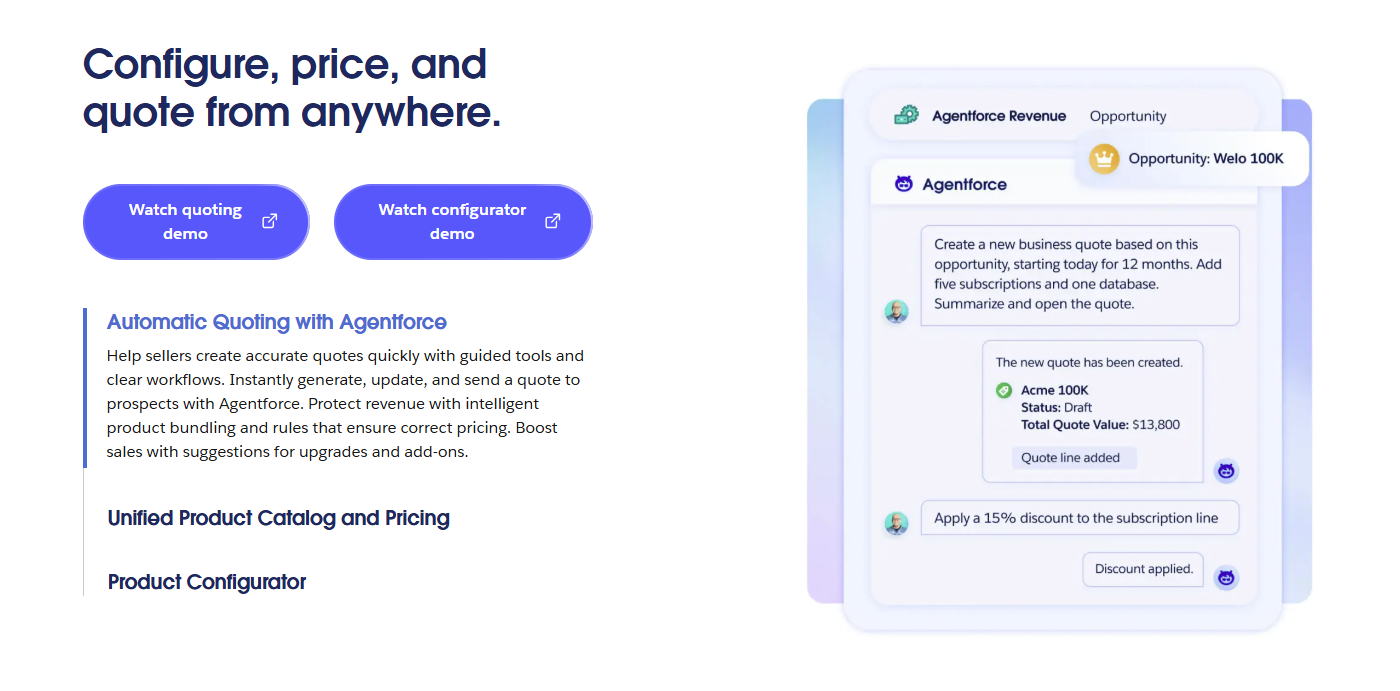
Salesforce Agentforce Revenue Management is the newer revenue platform that extends beyond the legacy Salesforce CPQ product.
Source: Salesforce.com
The system supports configuration, pricing, quoting, subscription management, and other revenue lifecycle processes while operating within the Salesforce environment.
Companies already heavily invested in Salesforce may appreciate having CPQ tied closely to CRM records and related sales workflows.
Its broader scope can also introduce additional implementation and administrative overhead, so smaller businesses with straightforward quoting requirements may find a lighter CPQ solution easier to manage.
Best Features
Salesforce-native workflow: Connect quoting directly with Salesforce CRM and opportunity data.
Product configuration: Apply product and configuration rules when reps assemble deals.
Pricing management: Control pricing and discounting within a governed sales process.
Subscription management: Support recurring revenue models and customer lifecycle changes.
Quote management: Build customer quotes using information already maintained in Salesforce.
Broader revenue capabilities: Advanced packages extend further into areas such as contracts, orders, consumption, and invoicing.
Pros
Deep Salesforce integration
Suitable for enterprise sales processes
Broad revenue lifecycle capabilities
Supports complex product structures
Strong governance options
Pricing
Salesforce publishes the following monthly per-user pricing, although both plans are billed annually:
Growth: $150/user/month. Provides CPQ and subscription management functionality.
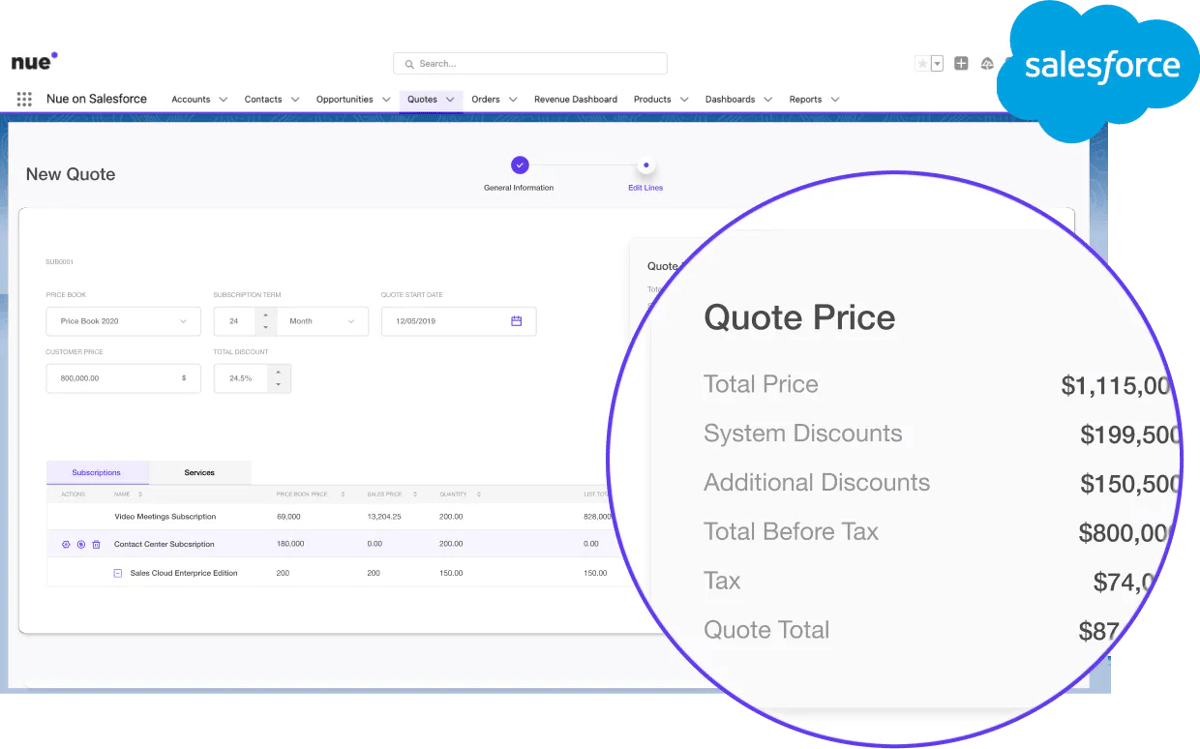
Nue is a quote-to-revenue platform designed around recurring, usage-based, and hybrid revenue models.
Source: G2
Its CPQ runs natively with Salesforce workflows and combines quoting with a larger revenue architecture covering subscriptions, usage, lifecycle management, and billing. Sales reps can configure pricing and discounting while Finance retains control over how deals are structured.
However, Nue's Salesforce-native architecture may be less convenient for businesses managing their sales processes in HubSpot.
Although Nue offers CPQ capabilities that integrate with Stripe Billing, its broader billing and revenue management features also rely on Nue's own platform.
So, companies that want to retain their existing billing infrastructure should evaluate which subscription changes and advanced pricing workflows are supported through the Stripe integration before committing to implementation.
Best Features
Flexible pricing: Quote subscriptions alongside structures such as usage, credits, commits, and services.
AI pricing configuration: Create pricing logic from natural-language instructions and apply predefined guardrails.
Guided selling: Use playbooks to direct reps toward approved deal structures.
Lifecycle management: Handle changes such as renewals, upgrades, co-terms, and other subscription events.
Billing and collections: Move quote terms into downstream invoicing and collections workflows.
Self-service APIs: Extend product and pricing logic into web or in-product buying experiences.
Pros
Strong support for modern pricing models
Combines CPQ and billing
Supports usage-based pricing
Built for subscription lifecycle management
Includes self-service capabilities
Integrates closely with Salesforce
Pricing
Nue does not publish monthly pricing on its website.
6. Subskribe
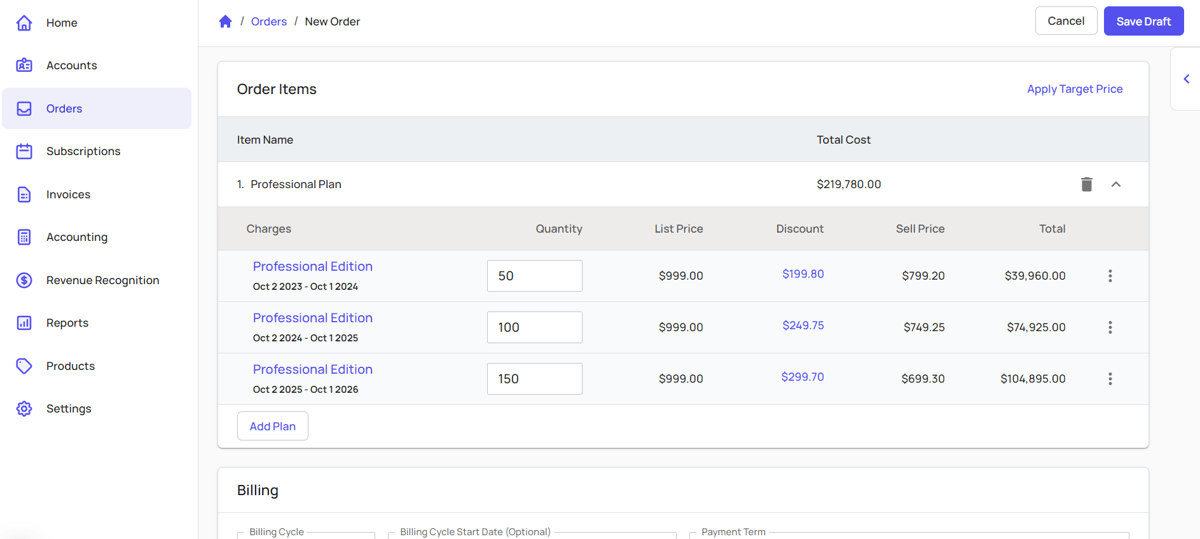
Subskribe offers CPQ as both a standalone product and part of a wider quote-to-revenue platform.
Source: G2
Its CPQ supports complex commercial agreements such as upsells, cross-sells, renewals, and restructures. Companies can also use Subskribe for billing and revenue recognition if they want those processes under one platform.
Subskribe offers standalone CPQ, so adopting its quoting software doesn't automatically require replacing your billing system. However, its complete quote-to-revenue experience relies on bringing CPQ, billing, and revenue recognition together.
Companies that prefer to continue using Stripe Billing should investigate how signed orders, subscription amendments, and complex pricing terms transfer into their existing setup. Maintaining separate systems may require additional integration work.
Best Features
Complex deal support: Manage renewals alongside other lifecycle changes such as upsells, cancellations, and restructures.
Flexible pricing: Support recurring, one-time, and usage-based pricing structures.
Approval management: Build order approval workflows around your sales process.
Discount controls: Apply multilevel discounting to customer orders.
Sales documents: Create customizable order forms and manage documents within the sales workflow.
Billing: Extend into order-based invoicing, subscription management, dunning, and usage-based billing.
Revenue recognition: Its wider quote-to-revenue offering supports ASC 606 and IFRS 15 revenue recognition workflows.
Pros
Handles complex subscription deals
Available as standalone CPQ
Supports Salesforce and HubSpot
Broad billing functionality
Includes native e-signature
Revenue recognition available
Pricing
Subskribe does not publish pricing publicly.
7. Hyperline
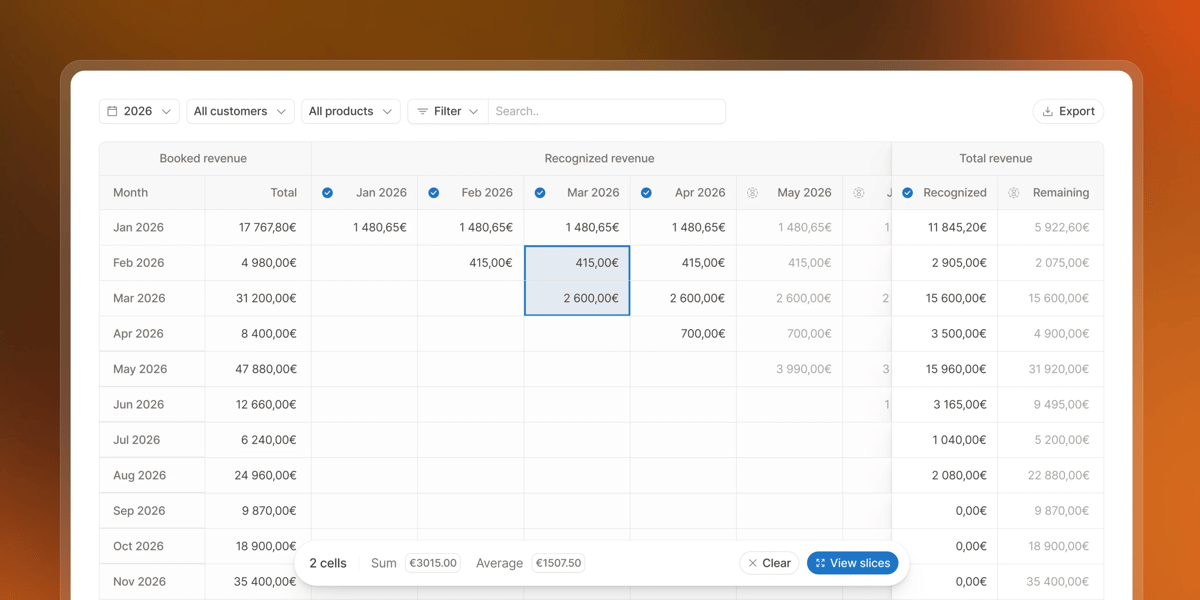
Hyperline combines CPQ with billing and broader revenue operations in one platform.
Its Launch plan already includes sales quotes and e-signatures alongside recurring billing and invoicing. Higher plans add capabilities such as usage-based pricing, revenue recognition, and advanced approval controls.
Source: G2
Hyperline may be more extensive than necessary for businesses primarily looking to improve their quoting process.
Although it supports keeping Stripe Billing through a dedicated CPQ integration, companies should confirm which advanced billing and revenue management capabilities are available when using Stripe as their billing engine.
Its broader platform also introduces additional functionality and pricing considerations that smaller teams may not need.
Best Features
CPQ and e-signature: Create sales quotes and collect signatures within the same revenue platform.
Flexible billing: Support recurring billing alongside hybrid and usage-based pricing.
Subscription management: Run subscriptions and related customer billing workflows from Hyperline.
Invoicing and payments: Generate invoices and automate payment collection.
Revenue recognition: Growth includes revenue recognition capabilities.
Advanced controls: Scale adds more sophisticated approval flows and commercial controls.
Integrations: Connect with systems including HubSpot, Salesforce, accounting platforms, and ERPs depending on your plan.
Pros
Combines CPQ and billing
Supports modern pricing models
Built-in e-signature
Includes invoicing and payments
Supports revenue recognition on higher plans
Broad finance functionality
Pricing
Hyperline currently publishes one entry-level price, with larger plans priced individually:
Launch: $299/month + 0.7% of revenue processed. Includes subscriptions, recurring billing, CPQ quotes, e-signature, invoicing, payments, and core integrations.
Growth: Custom. Adds capabilities such as usage-based and hybrid pricing, revenue recognition, and multi-currency billing.
Choose a Smart CPQ Solution That Fits the Rest of Your Revenue Stack
Your best LinePilot alternative comes down to how much of the sales and billing process you want your CPQ to handle.
Finrite is ideal if you want to keep the systems you already rely on. You can build quotes from CRM data, manage approvals and signatures, collect payment details during the sales process, and carry finalized pricing into Stripe Billing.
Renewals, upsells, usage-based pricing, ramps, and custom billing terms can stay connected to the original deal instead of being recreated later.
You also avoid taking on a separate billing platform just to get stronger CPQ functionality.
Book a Finrite demo to see how your team can connect quoting, contracts, and billing while keeping your existing revenue stack in place.
FAQs About LinePilot CPQ Alternatives
Which CPQ is best?
The best CPQ software depends on your CRM, pricing model, sales complexity, and what should happen after a quote is signed. A smaller team may prefer a simple CRM-connected quoting tool, while a company selling complex configurations or subscriptions may need deeper pricing rules, approvals, lifecycle management, and billing automation.
How much is CPQ?
CPQ pricing varies considerably. Some tools charge per user each month, while others use custom pricing based on factors like company size, functionality, or contract volume. Published prices in this list range from a few hundred dollars per month to enterprise CPQ plans costing hundreds of dollars per user each month.
What should I look for in a CPQ tool?
Start with the sales process you already have. Consider how the CPQ handles product configuration, pricing rules, discounting, approval workflows, CRM integration, quote creation, and subscription changes. You should also check what happens after signature. A CPQ that connects cleanly with your billing system can reduce duplicate data entry and manual handoffs between Sales and Finance.
Can CPQ software handle subscription and usage-based pricing?
Most CPQ tools support subscription pricing, but capabilities vary. More advanced platforms may also handle usage-based pricing, ramps, credits, or hybrid pricing models. Check how those terms transfer from the quote into billing as well. Supporting a pricing model during the sales process is far more useful when the same commercial terms can be executed accurately after the customer signs.
About Finrite
Finrite streamlines sales-led revenue workflows, without any billing engine change. Sales reps can send out proposals in seconds, and our HubSpot to Stripe Connector creates subscriptions, customers, and billing objects in moments.
Automate quote-to-cash. Keep your billing stack.
Give sales a faster way to quote and finance a reliable way to bill. Finrite connects your CRM, contracts, and billing to automate the work from proposal to subscription.