9 Top CPQ Software for Streamlining Sales Processes in 2026
9 Top CPQ Software for Streamlining Sales Processes in 2026
By:
Kunal Mehta
,
November 23, 2026
Creating a sales quote sounds straightforward until you have to account for custom pricing, discounts, and contract terms that change with every customer.
A simple spreadsheet might work for a few deals. But as your business grows, manual pricing calculations become harder to maintain, and sales reps can spend hours preparing quotes that still need several rounds of approval.
Configure-price-quote (CPQ) software helps solve these problems.
The best CPQ software automates quote creation, applies consistent pricing rules, and gives sales teams a more efficient way to manage complicated deals.
In this guide, we'll explore the top nine CPQ software options for streamlining sales processes, including their best features, advantages, and potential drawbacks, so you can find the right fit for your business.
TL;DR
The best CPQ software for streamlining sales processes are:
CPQ software gives sales reps a structured way to build quotes, especially when deals involve custom product combinations, negotiated discounts, or pricing that changes based on contract terms.
The software applies your company's pricing and configuration rules as each quote is prepared. That helps sales reps handle more complicated deals without repeatedly going back to finance for calculations or approvals.
Here's how the process generally works:
Configure: Sales reps select appropriate products or services based on customer requirements, with rules that prevent incompatible combinations.
Price: The software calculates accurate pricing using predefined logic, including discounts, contract pricing, and usage-based pricing models.
Quote: Sales reps generate professional proposals containing the approved configuration and commercial terms.
Approve: Automated approval workflows route deals to the appropriate decision-makers before customers receive their quotes.
Close: Depending on the platform, accepted quotes can move into contract management, electronic signatures, and billing workflows.
CPQ software is especially useful for businesses with complex pricing structures or customizable products.
Generally speaking, it can improve sales efficiency, reduce pricing mistakes, and shorten the sales cycle while giving customers clearer information about what they're purchasing.
9 Best CPQ Software Options to Optimize Your Sales Process
Finding the right CPQ software starts with understanding what your sales team needs help with. Are you trying to speed up quote creation, handle more complicated pricing, or connect your sales process with billing?
Let's look at the nine best CPQ tools that address these needs, along with their strengths and potential drawbacks.
1. Finrite
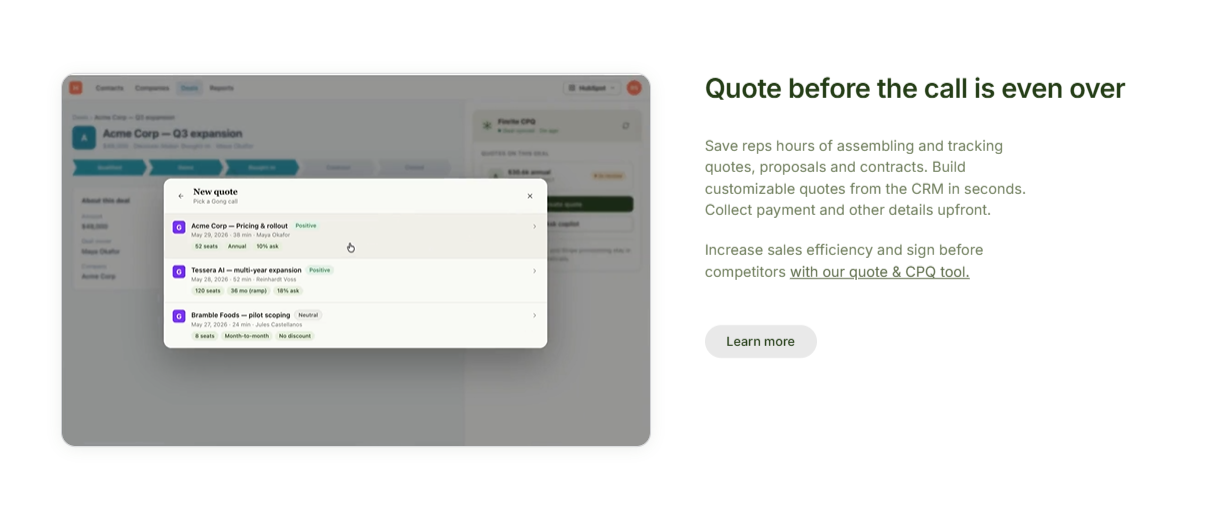
Finrite is a CPQ and revenue automation platform that helps businesses manage quoting, contracts, and billing through their existing CRM and billing systems.
It's ideal for SaaS companies that use HubSpot for sales and Stripe Billing for subscription management.
Finrite lets sales reps create customized quotes directly from CRM data. You can configure pricing, include conditional contract terms, and collect signatures without manually transferring information between systems.
The platform also handles complex pricing models, including usage-based pricing and multi-year agreements with changing rates.
One of Finrite's biggest advantages is its approach to billing. Many CPQ platforms introduce their own billing systems, which can create additional implementation work for companies already using Stripe.
But Finrite connects your quoting process directly to Stripe Billing, which allows signed deals to become subscriptions without a billing migration.
Your team can also manage renewals and amendments to existing Stripe subscriptions through CRM-connected workflows.
If you sell subscriptions through both self-service checkout and sales reps, Finrite lets you manage billing through Stripe without introducing separate systems for each sales channel.
Best Features
CRM-embedded quote builder: Create accurate quotes directly from HubSpot deal data using customizable templates, product information, and conditional contract terms.
Flexible pricing models: Support recurring subscriptions, usage-based pricing, custom payment terms, and ramp schedules through Stripe Billing.
Automated quote approvals: Manage deal authorization and track quote progress before sending agreements for signature.
Electronic signatures: Collect signatures and payment details during the quote acceptance process, with reminders for outstanding agreements.
HubSpot-Stripe integration: Automatically create Stripe customers, subscriptions, and invoices using approved CRM information.
Subscription management: Handle renewals and upsells that update existing Stripe subscriptions instead of creating disconnected billing records.
Bidirectional data synchronization: Keep customer details, subscription records, and billing status connected to the relevant CRM deals.
AI Contract Parser: Extract commercial terms from third-party agreements, review the information, and turn approved details into Stripe billing records.
Revenue operations tools: Manage product and price mappings, support billing changes, and improve visibility into existing subscriptions.
Pros
No billing migration required
Native HubSpot and Stripe connectivity
Support for complex SaaS pricing
Automated quote-to-billing workflows
Flexible contract templates
Subscription amendments and renewals
Payment collection during quoting
Fast implementation
AI-powered contract processing
Book a Finrite demo to see how your sales team can streamline quoting while keeping Stripe Billing.
2. DealHub
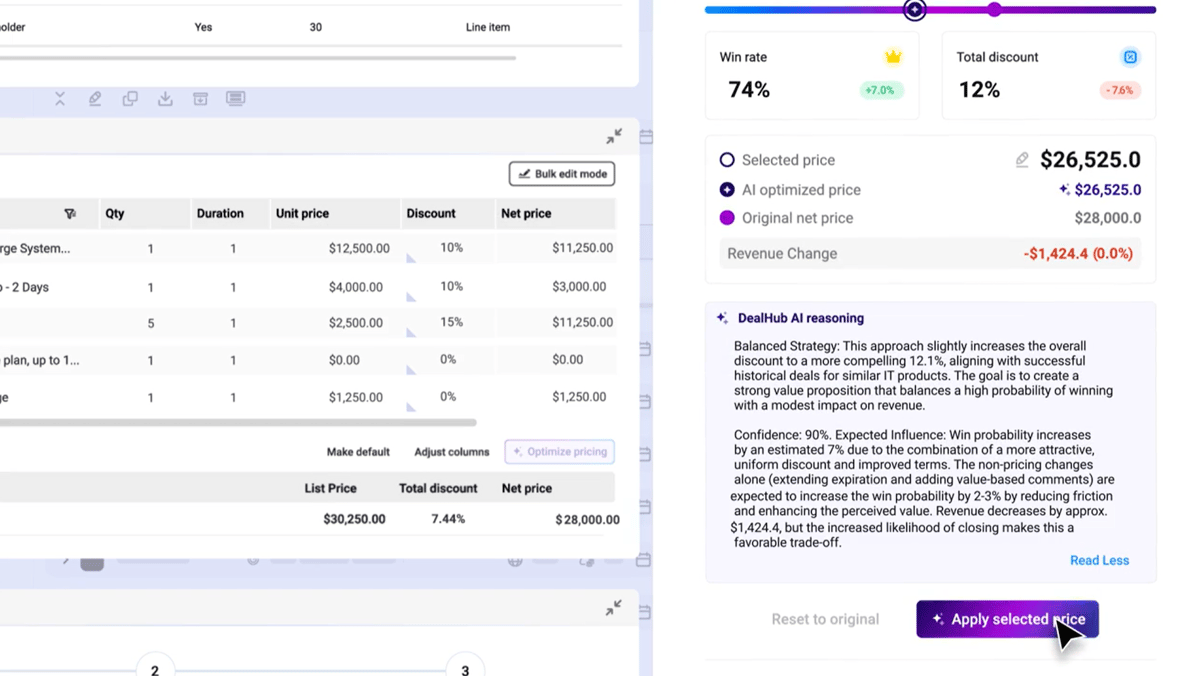
DealHub is an AI-powered quote-to-revenue platform that combines CPQ software with contract management, subscription operations, and billing. It's designed for businesses that want to manage complicated sales processes using a connected revenue platform.
Sales reps can follow guided selling workflows that recommend appropriate products based on customer requirements. DealHub then applies pricing rules and identifies deals requiring additional approvals.
Source: G2
Its digital sales room also gives buyers a dedicated space to review proposals and interact with sales representatives.
DealHub has expanded its capabilities beyond quoting, offering billing automation and subscription lifecycle management for recurring and usage-based revenue. The broader functionality can be attractive to enterprises trying to consolidate multiple revenue systems.
There are trade-offs, though. Implementing DealHub can involve substantial configuration, especially if you have complicated approval processes or custom pricing logic.
Its broader billing offering may also overlap with your existing Stripe Billing setup. Adopting DealHub as your billing system could mean migrating subscriptions or maintaining separate billing workflows.
You might want to consider the total cost of ownership, including implementation and ongoing administration, before committing to the platform.
Best Features
Guided selling: Help sales reps select suitable product configurations through interactive questions and predefined sales rules.
Advanced pricing engine: Support complex pricing structures, including tiered pricing, negotiated discounts, and usage-based models.
Approval workflows: Route quotes based on commercial conditions, including discount thresholds or contract requirements, to the appropriate reviewers.
Digital sales rooms: Provide buyers with branded spaces to review proposals, share feedback, and complete agreements.
Subscription lifecycle management: Manage recurring contracts, expansions, renewals, and amendments through connected revenue workflows.
Revenue analytics: Monitor deal information and commercial performance using reporting tools connected to the quoting process.
Billing automation: Convert approved commercial terms into billing operations using DealHub's subscription billing capabilities.
Pros
Comprehensive revenue management functionality
Strong guided selling capabilities
Flexible pricing configuration
Digital sales room experience
Advanced approval automation
Subscription lifecycle support
AI-assisted quoting features
3. Salesforce Agentforce Revenue Management
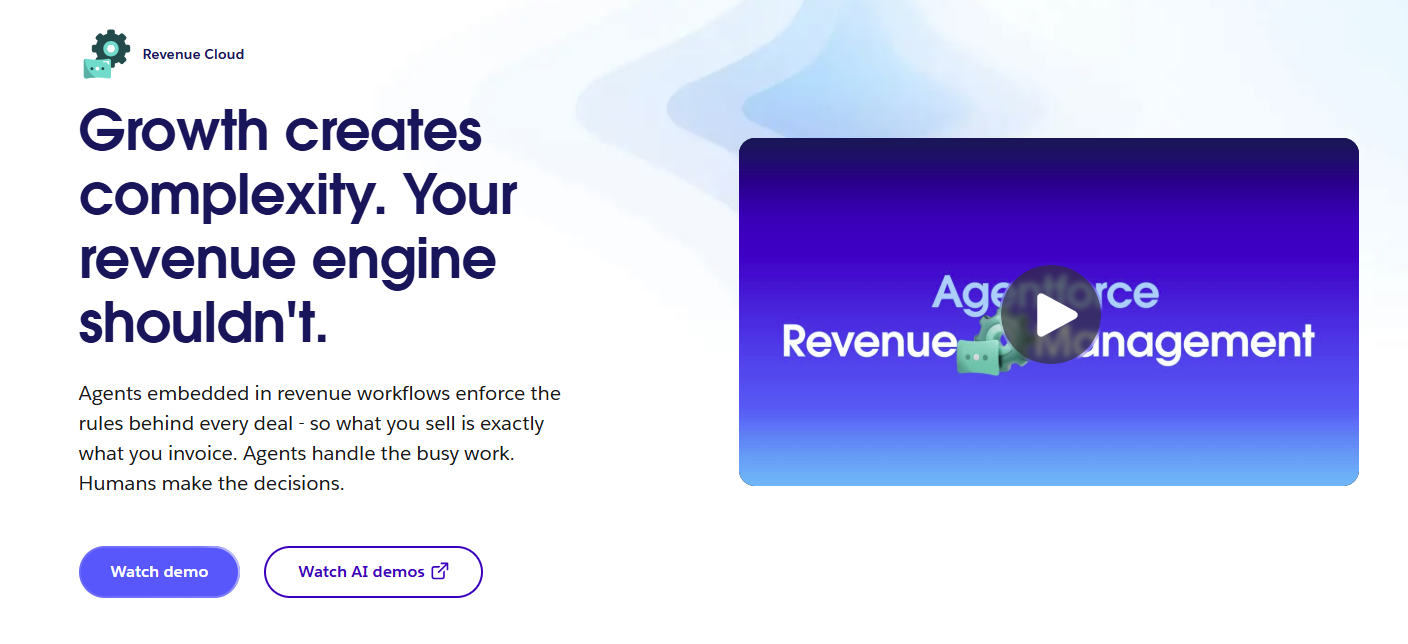
Salesforce Agentforce Revenue Management is an enterprise revenue management platform that supports product configuration, pricing, quoting, and downstream revenue operations.
Previously known as Revenue Cloud, it offers modern revenue management capabilities beyond Salesforce's legacy CPQ product.
Source: Salesforce.com
Companies already using Salesforce CRM can manage complex sales transactions through a familiar data environment.
The platform supports sophisticated configuration rules, which let sales reps build quotes for complicated products while maintaining consistent pricing.
Plus, Salesforce provides capabilities for subscriptions, usage calculations, and contract lifecycle management.
However, the biggest consideration is implementation. Salesforce offers extensive customization, but configuring its revenue management software for your business can demand significant technical expertise.
Larger organizations often need dedicated Salesforce administrators or implementation consultants to maintain complex workflows.
Best Features
Advanced product configuration: Apply compatibility rules and product constraints to manage complex product configurations without relying on manual checks.
Automated pricing: Calculate prices using configured pricing logic, discounts, and commercial conditions to maintain pricing consistency.
Guided selling: Help sales reps identify suitable offerings through structured configuration workflows and AI-supported assistance.
Contract lifecycle management: Support contract creation and ongoing agreement changes through connected revenue management processes.
Subscription and usage management: Handle recurring agreements, usage consumption, and changes to customer subscriptions.
Order and billing management: Connect approved quotes with downstream fulfillment and billing capabilities, depending on the edition and configuration.
Salesforce integration: Use Salesforce customer data and revenue records to improve visibility into sales performance and ongoing accounts.
Pros
Deep Salesforce CRM integration
Powerful product configuration
Enterprise-grade pricing controls
Advanced revenue lifecycle management
Flexible workflow customization
Strong subscription capabilities
Extensive Salesforce ecosystem
4. HubSpot CPQ
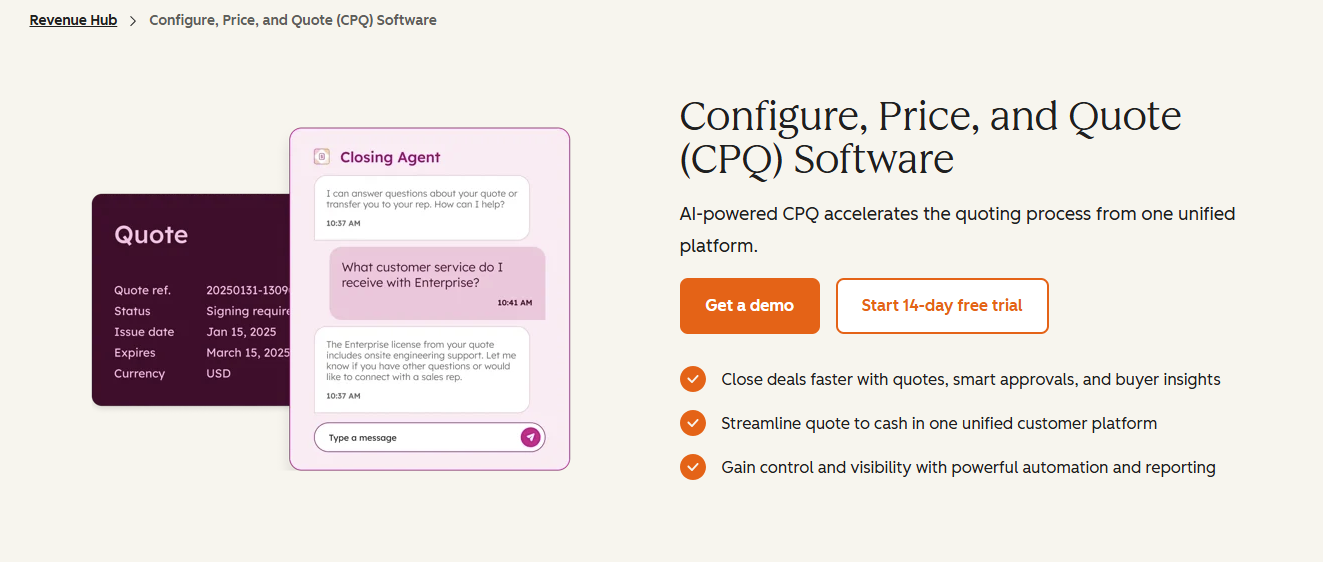
HubSpot CPQ is a configure-price-quote solution available through HubSpot Revenue Hub that helps sales teams create and manage quotes directly inside their CRM.
Its main advantage is convenience. Your sales representatives already have customer data and deal information in HubSpot, so they can generate quotes without introducing another standalone quoting platform.
Sales managers can also set up approval workflows to control discounts and other commercial terms before quotes reach customers. Advanced approval workflows are available with Revenue Hub Enterprise.
HubSpot has expanded its revenue capabilities to include contract and billing workflows, making it a practical option for businesses that prefer a CRM-centered sales process.
Still, its billing capabilities may be less suitable for sophisticated subscription models than a dedicated platform like Stripe Billing.
Companies working with complicated usage-based charges or multi-phase subscription schedules should evaluate those requirements carefully.
So, if your business already relies on Stripe Billing for complex recurring revenue, moving those processes into HubSpot could introduce unnecessary changes to your billing operations.
Best Features
CRM-native quote creation: Generate quotes using HubSpot deal records and existing customer information without switching applications.
Product and pricing management: Organize product catalogs, define price books, and apply supported pricing rules during quote creation.
Quote approval workflows: Configure standard approval requirements, with advanced workflow-based authorization available on Enterprise.
Electronic signatures: Allow customers to accept quotes digitally and complete agreements through supported signature methods.
Branded quote templates: Customize quote layouts and commercial details to create consistent customer-facing documents.
Payment collection: Connect supported payment processing options to quotes for a smoother purchasing experience.
Quote activity tracking: Monitor buyer interactions and review quote status directly through HubSpot's CRM interface.
Pros
Native HubSpot integration
Familiar CRM interface
Built-in electronic signatures
Convenient quote tracking
Flexible approval options
Integrated payment capabilities
Minimal additional software for simple deals
5. PandaDoc
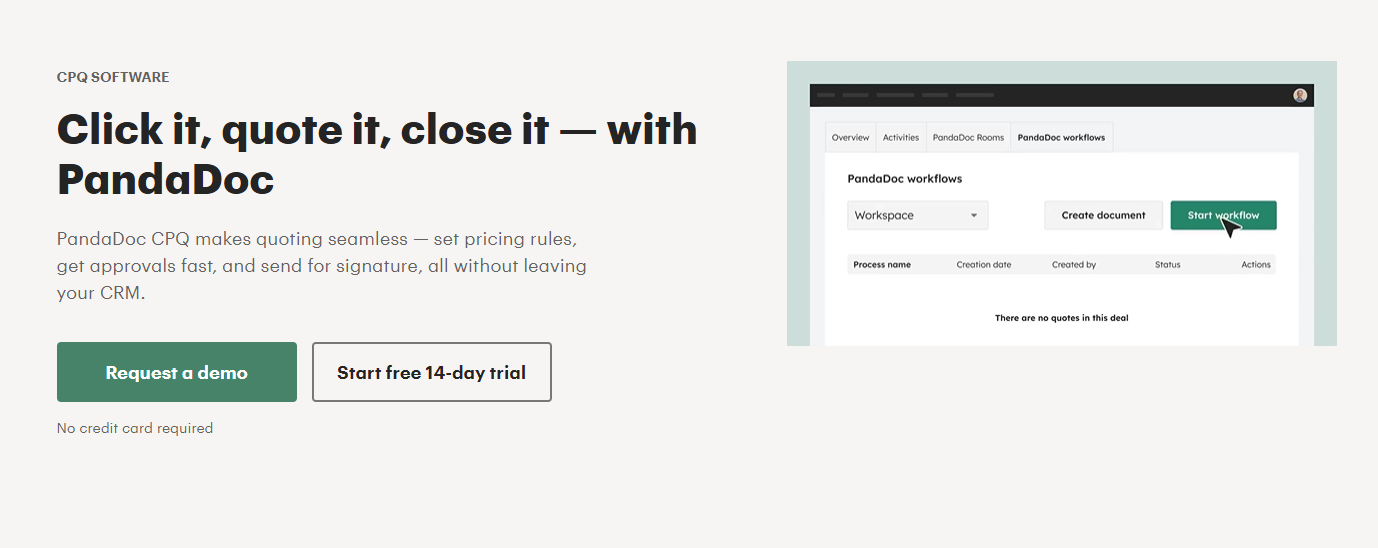
PandaDoc is a document automation and CPQ platform that helps sales teams create quotes, proposals, and agreements using customizable templates.
Its biggest strength is document creation. Sales reps can prepare professional proposals that include pricing tables and interactive product options, giving customers a clearer way to review an offer.
PandaDoc also supports CPQ functionality, including automated pricing calculations and guided selling.
Source: PandaDoc.com
Integrations with popular customer relationship management systems, such as HubSpot and Salesforce, allow representatives to generate documents using existing deal information.
So, for companies dealing with lengthy proposals or complex approval requirements, its document workflows can reduce repetitive administrative work.
But PandaDoc has limitations worth considering. Its advanced CPQ functionality is available on the Enterprise plan, and certain features may require additional usage credits or paid add-ons.
More importantly, document acceptance and subscription billing are separate concerns.
PandaDoc can help you collect payments, but its native capabilities don't replace the advanced subscription management available in Stripe Billing.
Businesses handling usage-based charges or complicated renewals may still need additional integrations to translate signed agreements into the correct billing records.
Best Features
Document automation: Generate branded proposals and contracts using reusable templates and content from your existing sales records.
CPQ pricing engine: Apply product configuration rules, discounts, and custom pricing conditions to generate accurate quotes.
Interactive pricing tables: Let customers review available products and select suitable options within supported quote configurations.
Guided selling: Help representatives assemble appropriate product bundles using predefined configuration requirements.
Approval automation: Route documents for authorization based on pricing thresholds or other configured business rules.
Electronic signatures: Collect signatures digitally and track document activity throughout the approval and signing process.
CRM integrations: Connect PandaDoc with supported CRMs to populate quotes and maintain sales document visibility.
Pros
Excellent document customization
Professional proposal templates
User-friendly document editor
Strong electronic signature functionality
Interactive pricing options
Popular CRM integrations
Automated document workflows
6. Conga CPQ
Conga CPQ is an enterprise quoting solution that helps businesses configure products, automate pricing, and manage complicated commercial agreements.
It's useful for companies selling highly configurable products, such as manufacturers and large technology providers.
Source: Conga.com
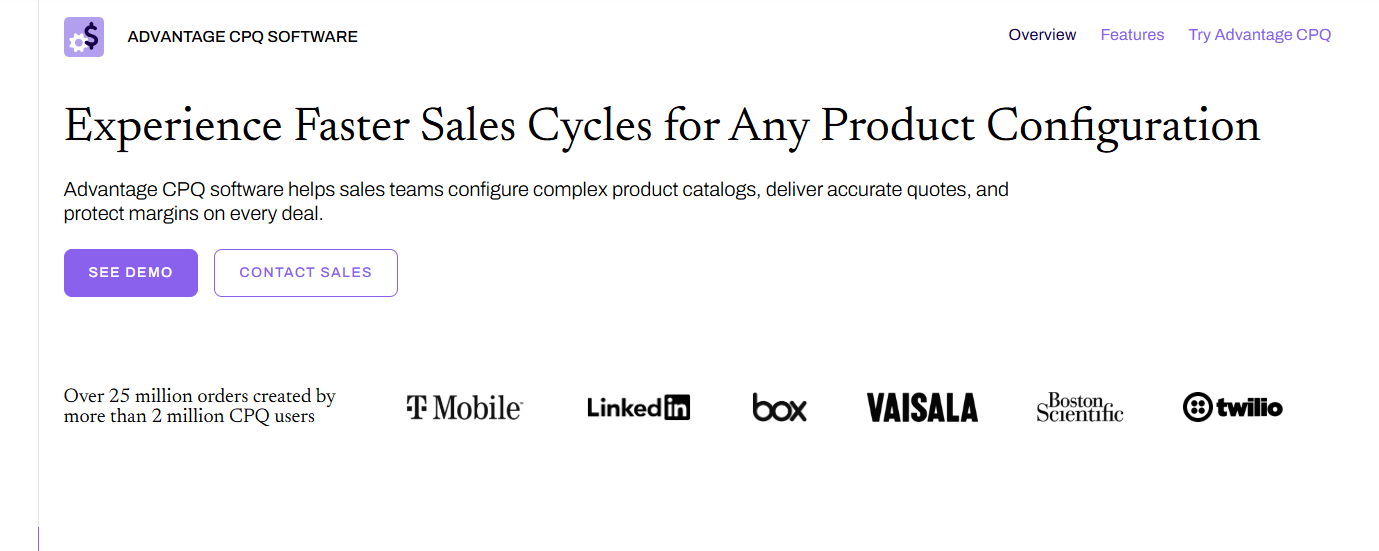
Conga offers different CPQ solutions, including Smart CPQ and Advantage CPQ, to address different technical requirements. Smart CPQ focuses on complex product configuration and high-volume quoting, while Advantage CPQ supports Salesforce-native revenue workflows.
The software can enforce product compatibility requirements and apply complex pricing rules, helping sales reps avoid quoting configurations that cannot be delivered.
Conga also offers contract lifecycle management and related revenue management capabilities through its broader product portfolio.
Still, the extensive functionality comes with potential challenges. Setting up complicated product rules and integrations may require professional services or experienced administrators.
Companies with straightforward subscription products could find Conga's configuration capabilities unnecessarily extensive.
You'll also want to check which additional Conga modules are necessary for your billing workflows. Depending on your existing systems, connecting CPQ with contracts and downstream invoicing may increase implementation costs.
Best Features
Complex product configuration: Handle sophisticated product catalogs with compatibility rules that guide sales reps toward valid configurations.
Advanced pricing rules: Automate pricing calculations using commercial conditions, including negotiated rates, promotions, and volume discounts.
Guided selling: Help representatives select suitable products through configuration logic tailored to customer requirements.
Automated approval workflows: Route complex deals through authorization processes based on configured pricing and commercial conditions.
High-volume quoting: Support large product configurations and quotes containing extensive numbers of line items.
Contract management integration: Connect quoting with Conga's contract lifecycle management capabilities for document creation and agreement execution.
CRM and ERP connectivity: Integrate pricing and configuration processes with supported enterprise systems and downstream business workflows.
Pros
Advanced product configuration capabilities
Strong enterprise pricing controls
Support for large product catalogs
Flexible integration architecture
Detailed configuration rules
Contract management options
Suitable for complex enterprise sales
7. Oracle CPQ
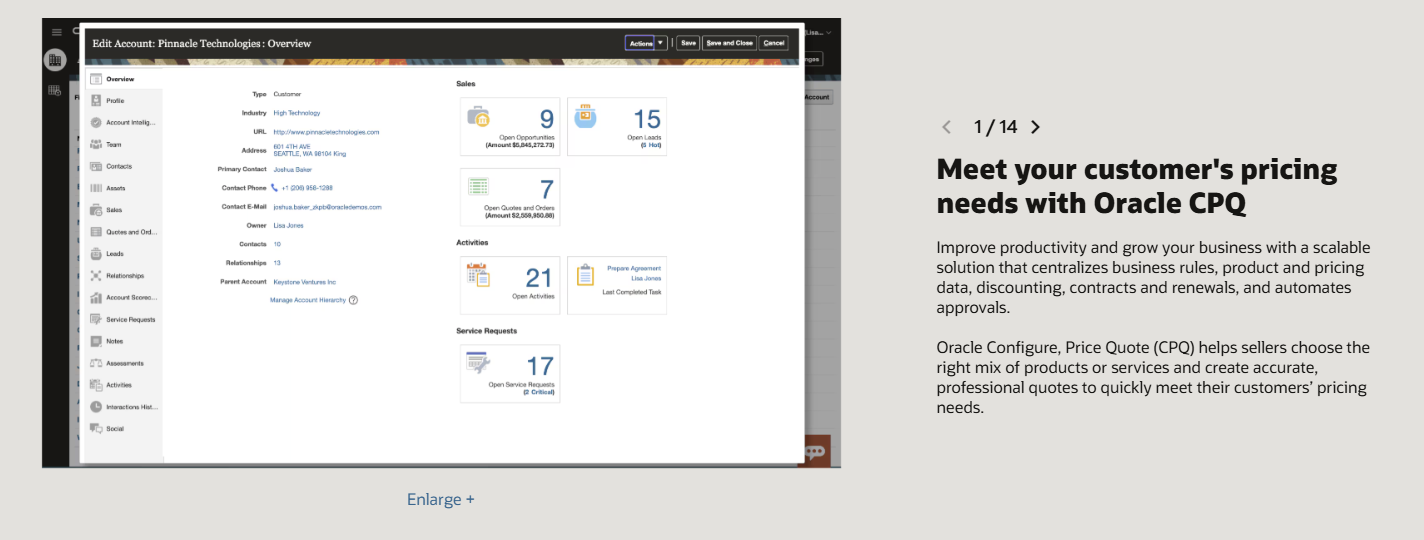
Oracle CPQ is an enterprise CPQ platform that automates complex product configuration and pricing processes.
The software is designed for organizations that sell highly customizable products or services requiring detailed configuration logic.
For instance, a manufacturer might offer equipment with multiple technical options. Oracle CPQ helps sales reps select compatible components and calculate the correct price based on the final configuration.
Source: Oracle.com
Its guided selling capabilities also support businesses that need to manage large catalogs without requiring every representative to understand the technical details of each product.
Oracle CPQ Cloud integrates with Oracle's broader enterprise software portfolio and supports connections to other customer relationship management systems. The platform can be especially useful for organizations already investing in Oracle infrastructure.
The main drawback is complexity. Implementing Oracle CPQ often requires detailed product modeling and careful integration planning. Businesses may need dedicated administrators or implementation partners to maintain sophisticated configuration rules.
Its enterprise-oriented architecture can increase the total cost of ownership for smaller companies.
Generally, organizations primarily selling straightforward SaaS subscriptions may find Oracle's capabilities excessive, particularly if their existing billing systems already handle complex recurring revenue.
Best Features
Advanced product configuration: Manage products with extensive options and technical dependencies using reusable configuration models.
Guided selling: Walk sales representatives through product selection to help identify appropriate configurations for individual customers.
Automated pricing calculations: Apply pricing logic and commercial conditions to generate accurate pricing for complicated orders.
Real-time configuration: Allow sales teams and customers to collaborate on product selections through supported digital experiences.
Approval workflows: Automate authorization procedures for deals that exceed pricing limits or require additional review.
Subscription quoting: Configure recurring products, software licenses, and service agreements with supported renewal pricing.
Enterprise integration capabilities: Connect Oracle CPQ with CRM and ERP systems to support downstream order processing.
Pros
Sophisticated configuration engine
Strong guided selling functionality
Advanced pricing calculations
Extensive enterprise integrations
Support for complex products
Flexible approval processes
Scalable enterprise architecture
8. Subskribe
Subskribe is a CPQ and quote-to-revenue platform designed for SaaS businesses managing complicated subscription agreements.
Unlike traditional enterprise CPQ systems built around physical product configurations, Subskribe focuses on the commercial requirements of recurring revenue.
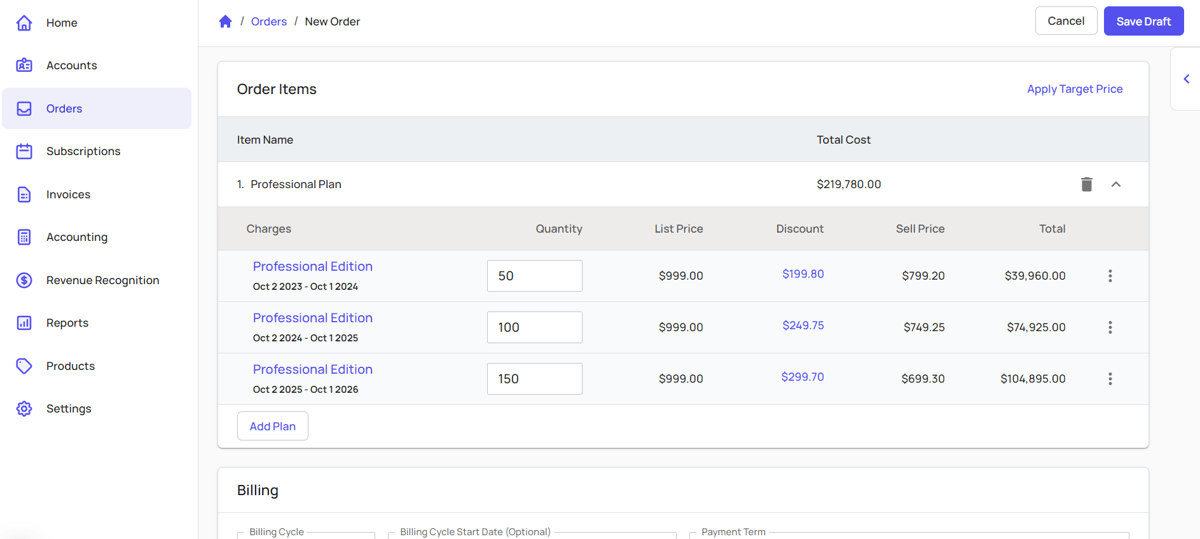
Sales reps can create quotes for multi-year contracts with changing prices, negotiate discounts, and manage subscription amendments.
Source: G2
Additionally, its pricing engine supports different subscription models, including usage-based pricing and tiered pricing.
Subskribe offers native integrations with Salesforce and HubSpot, allowing sales teams to work with existing CRM information.
The company provides standalone CPQ capabilities alongside a broader quote-to-revenue offering that includes billing and revenue recognition. The distinction is important if you're evaluating Subskribe for an existing technology stack.
Its standalone CPQ product may fit your quoting requirements, but adopting the complete revenue platform involves a larger operational decision.
Businesses already using Stripe Billing should evaluate how Subskribe's billing capabilities would coexist with their current subscriptions.
Migrating billing processes or maintaining multiple systems could add expenses and administrative work that offset some of the improvements in sales productivity.
Best Features
SaaS-focused quote builder: Create quotes for subscription products using flexible pricing models and configurable commercial terms.
Ramp deal support: Structure multi-year agreements with scheduled pricing changes and varying subscription quantities.
Usage-based pricing: Support consumption-based charges alongside recurring and one-time fees in customer agreements.
Automated approval workflows: Trigger approvals based on deal characteristics, such as contract values or discount levels.
Subscription lifecycle management: Generate quotes for renewals and amendments using existing customer agreements.
Digital sales rooms: Give customers an interactive environment to review proposed terms and collaborate during negotiations.
Revenue analytics: Track deal-level metrics, including annual recurring revenue and total contract value, to improve sales visibility.
CRM integrations: Connect with Salesforce and HubSpot to synchronize relevant account and opportunity information.
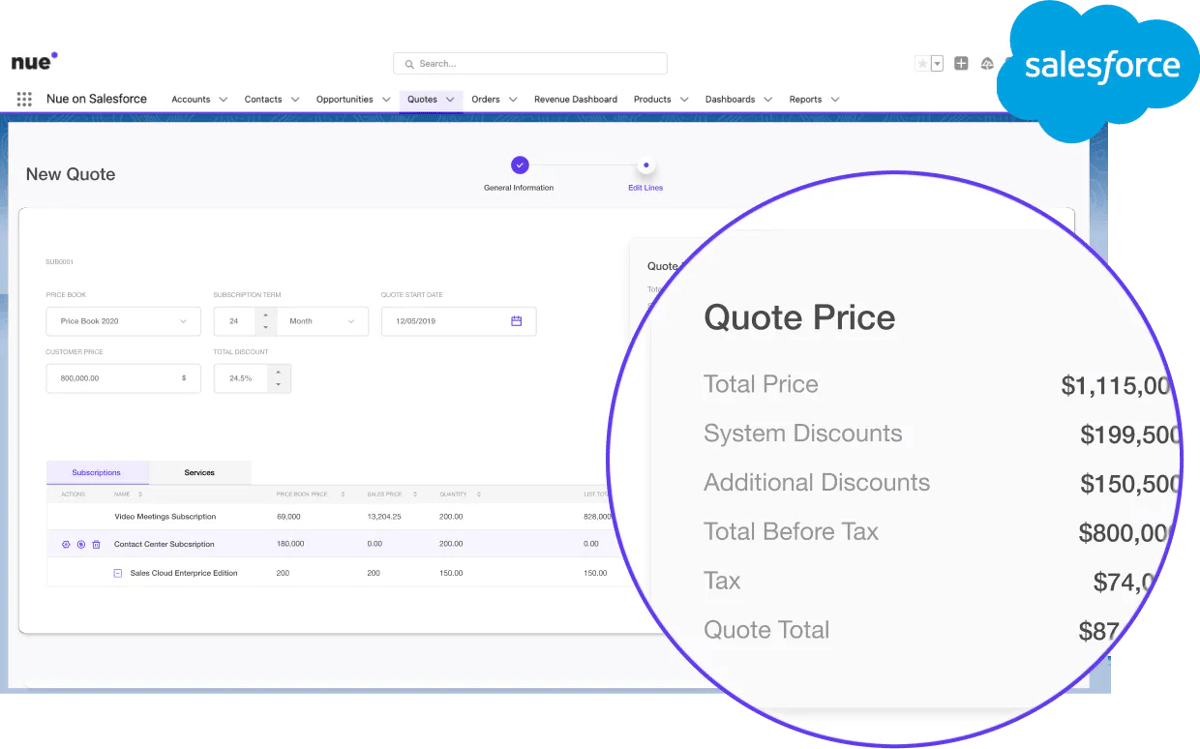
Nue is a revenue lifecycle management platform that combines Salesforce-native CPQ with subscription management and billing automation. It focuses on SaaS and AI businesses that need flexible monetization capabilities.
Companies offering subscription products with different pricing models can use Nue to manage commercial terms directly within Salesforce.
For example, a software company might sell a base subscription with usage-based charges and negotiated discounts. Nue helps structure the agreement and maintain its pricing logic as the customer relationship develops.
Source: G2
The platform also supports contract amendments and subscription changes, which allows sales teams to manage existing accounts.
Its broader revenue capabilities include consumption tracking and billing, with APIs for supporting self-service purchasing channels.
Nue's Salesforce-centered architecture is an important consideration. Salesforce users may benefit from native quoting, but companies primarily operating in HubSpot could face additional integration work.
Plus, the platform offers its own billing infrastructure. Organizations that want to retain Stripe Billing should examine how Nue's subscription and billing functions would interact with their existing setup.
A broader implementation may introduce additional complexity if your primary requirement is better quoting rather than a new revenue management system.
Best Features
Salesforce-native CPQ: Build and manage quotes directly inside Salesforce using existing account information and opportunity records.
Flexible pricing configuration: Support subscription models, usage-based charges, and custom pricing logic for SaaS products.
AI-assisted pricing: Help administrators create pricing rules and identify potential conflicts through AI-powered configuration tools.
Guided selling: Apply defined sales playbooks and commercial guardrails to help representatives structure deals.
Subscription lifecycle management: Manage renewals, upgrades, and amendments while maintaining existing customer subscription records.
Usage management: Track consumption and support billing structures involving credits or usage commitments.
Revenue reporting: Monitor subscription changes and revenue metrics to improve visibility into ongoing customer relationships.
Self-service APIs: Extend product pricing and purchasing capabilities to supported digital sales channels.
Pros
Native Salesforce quoting experience
Modern SaaS pricing capabilities
AI-assisted pricing configuration
Subscription lifecycle automation
Usage-based billing support
Revenue reporting functionality
Self-service API capabilities
Close Deals Faster and Let Finrite Handle the Billing
Your sales team has worked out the pricing, negotiated the contract, and secured the customer's signature. Everything is ready to go.
Except finance still needs to set up the subscription in Stripe.
It's a frustrating extra step, especially when the information already exists in HubSpot. If a customer has negotiated custom pricing or a subscription that changes over time, the manual setup becomes even more complicated.
Finrite connects your quoting and billing workflows so you can avoid these extra steps.
Your sales reps can build customized quotes in HubSpot, manage approvals, and collect signatures and payment details. Finrite then uses the agreed contract terms to create the appropriate billing records in Stripe.
Need to increase a customer's subscription later? You can handle upgrades, renewals, and other contract changes without starting the billing process over.
You'll also keep Stripe Billing for your existing subscriptions, including self-service customers and usage-based plans.
FAQs About the Top CPQ Software for Streamlining Sales Processes
What is the best CPQ software for sales teams?
The best CPQ software depends on your existing business systems and sales requirements. Finrite is a strong option for SaaS businesses using HubSpot and Stripe Billing, particularly those managing complex subscription pricing. Salesforce Agentforce Revenue Management and Oracle CPQ are better suited to larger enterprises with sophisticated configuration needs.
PandaDoc can be a practical choice for businesses primarily focused on proposals and document approvals. Evaluate each platform's pricing capabilities, integration requirements, and implementation costs before making a decision.
How does CPQ software improve sales efficiency?
CPQ software improves sales efficiency through automated product configuration, pricing calculations, and quote generation. Sales representatives can create accurate quotes using predefined business rules instead of manually checking product information and calculating discounts.
Automated approval workflows also help reduce delays caused by lengthy authorization processes. Faster quoting allows sales reps to spend more time communicating with potential customers, while consistent pricing helps reduce errors that could affect customer satisfaction.
Can CPQ software integrate with CRM and billing systems?
Yes. Many CPQ software solutions integrate with popular CRM platforms, including Salesforce and HubSpot. Billing integration capabilities vary considerably between vendors. Certain CPQ platforms provide their own billing systems, while other solutions connect with existing financial infrastructure.
Finrite, for example, allows businesses to connect CRM-based quoting with Stripe Billing. Before choosing a CPQ system, confirm that its integrations support your required pricing models and subscription changes, rather than checking only for basic data synchronization.
What should you consider before implementing CPQ software?
Start with your current sales process and identify the activities creating the most work for your sales team. Consider the complexity of your products, pricing requirements, and approval workflows. You'll also want to evaluate how the software integrates with your existing CRM and billing platforms.
Implementation time, administrative requirements, and subscription costs can affect the total investment. A CPQ solution that fits your current technology stack may provide better long-term efficiency than a more complex platform requiring extensive customization.
About Finrite
Finrite streamlines sales-led revenue workflows, without any billing engine change. Sales reps can send out proposals in seconds, and our HubSpot to Stripe Connector creates subscriptions, customers, and billing objects in moments.
Automate quote-to-cash. Keep your billing stack.
Give sales a faster way to quote and finance a reliable way to bill. Finrite connects your CRM, contracts, and billing to automate the work from proposal to subscription.